

(This post goes into detail and is likely mostly of interest to my Danish followers.)
General results
As I discussed in my previous post, I think there are two important questions for Denmark: The tax burden and immigration. Everything else is details / distractions.
All of the Danish politicians have answered a questionnaire (DR's kandidattest) about various political questions. So from this we can see their position on these two most important axes:
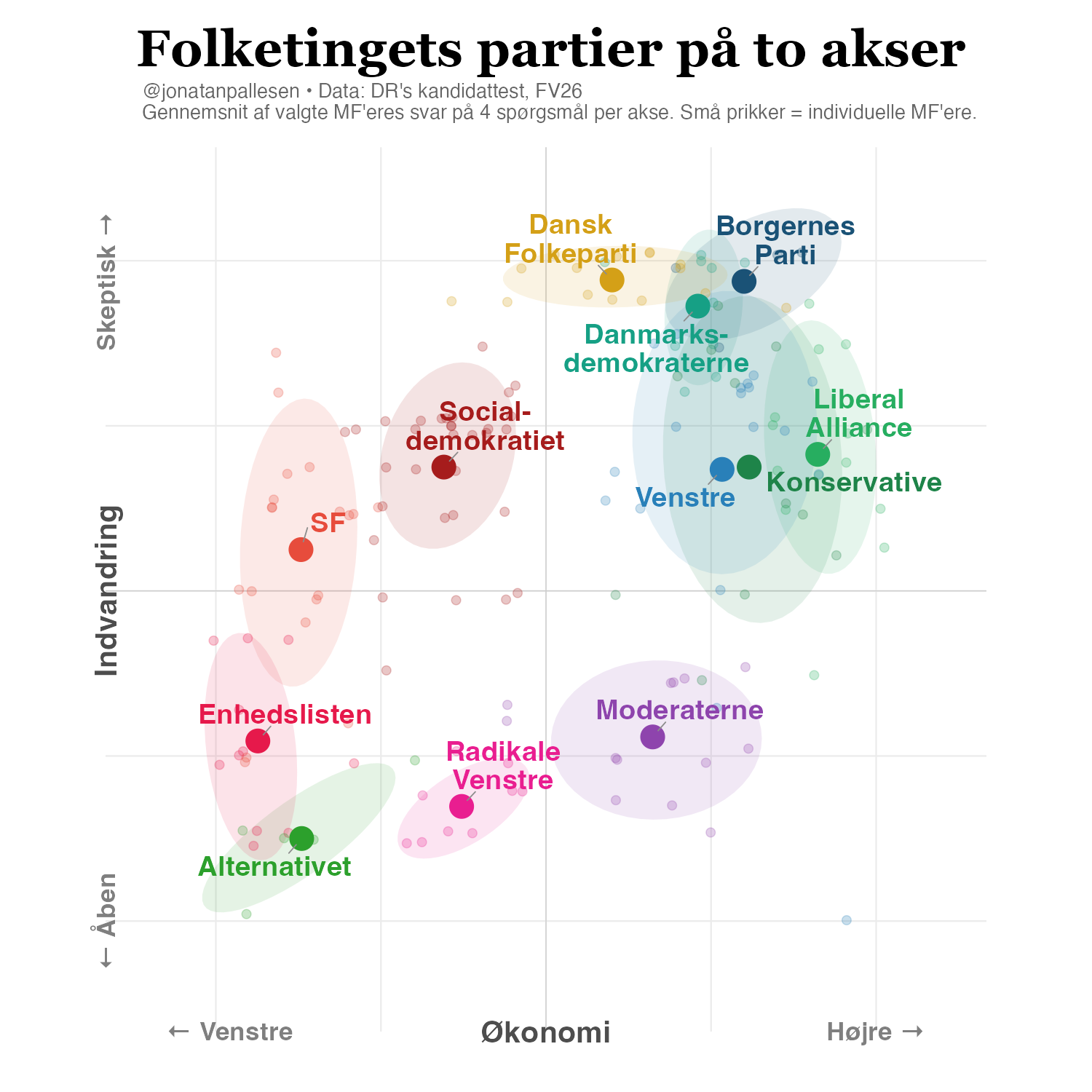
These two axes illustrate the conundrum the parliament is currently facing regarding the forming of the government. There is no grouping that can get a majority without containing at least two parties that are at opposite ends for one of the two axes.
In Denmark, when we are talking left-wing on the economic axis, we are talking really left-wing.
A remarkable half (49%) of elected politicians do not want all of us to get richer, if this means that economic inequality also increases.
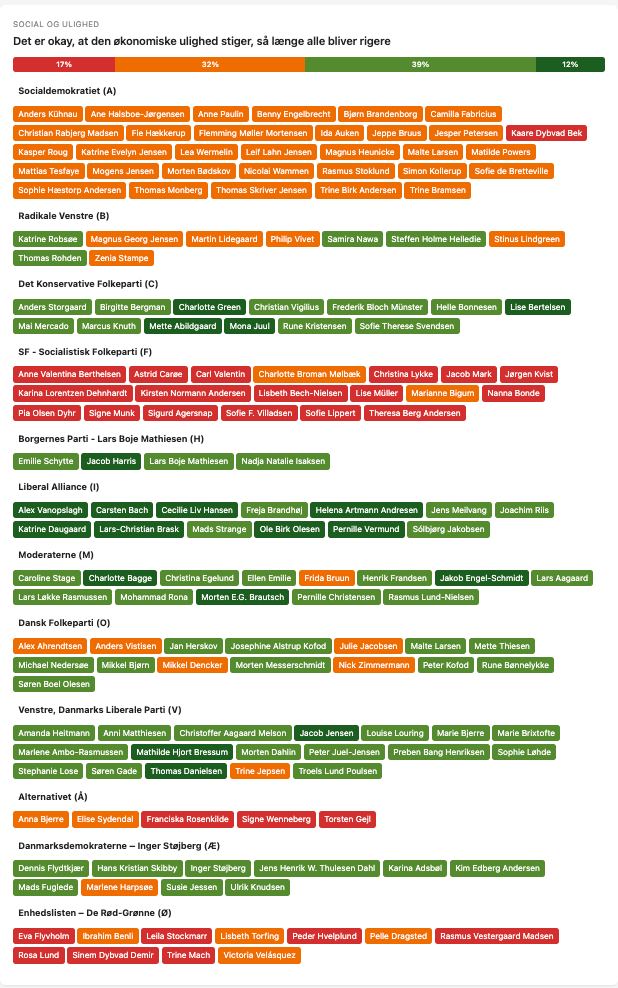
This is really an extreme view. You could equivalently say that they prefer all of us to be poorer, as long as the richest among us have reduced their wealth even more. No wonder that Denmark is the country in the world with the highest tax burden.
Young people elected
People have noticed that many young women have been elected to parliament this election. In the image below we have Helena Artmann, LA, 24 years old; Cecilie Liv Hansen, LA, 24 years old; Sofie Therese Svendsen (K), 23 years old. There are also many more young candidates elected.

In my opinion there should be age bounds on sitting in parliament. Something like 27 to 77. Young people tend to not know very much about the world. Which is bad when they are the ones making the laws we all live under.
Cecilie Liv Hansen (24) won the seat over Steffen Larsen (42). He was the spokesperson for the party for legal affairs and for immigration and integration. He has been highly engaged and involved in politics over the last term. She is a political lightweight who possibly also has some issues with her private life. But young people, especially young women, have more followers on Instagram, which makes it easier for them to win personal votes (which we use in Denmark to decide who gets into parliament within each party). This is not a great system, especially since Instagram followers can easily be there for reasons other than political content.
Cecilie Liv Hansen has some unfortunate political opinions. For example, she strongly agrees that we should open up for more worker immigration from outside the West. The workers from outside that we have gotten historically have been a disaster. But perhaps she is not aware of this?
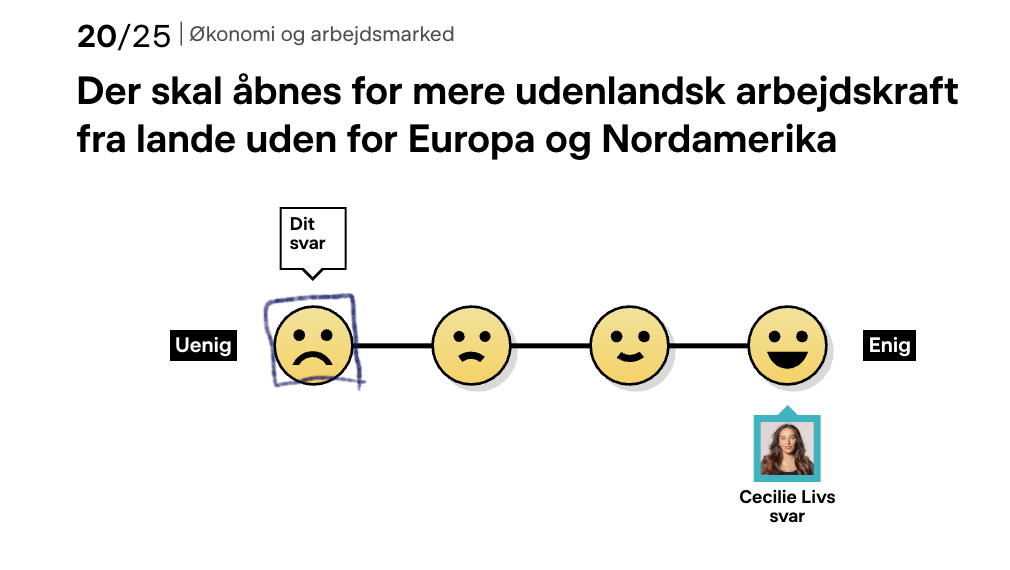
Unlike Steffen Larsen, she is not in alignment with her party on this issue. We can see in the figure below that she is far more pro-immigration than her party, more in line with Enhedslisten or Moderaterne on that axis.
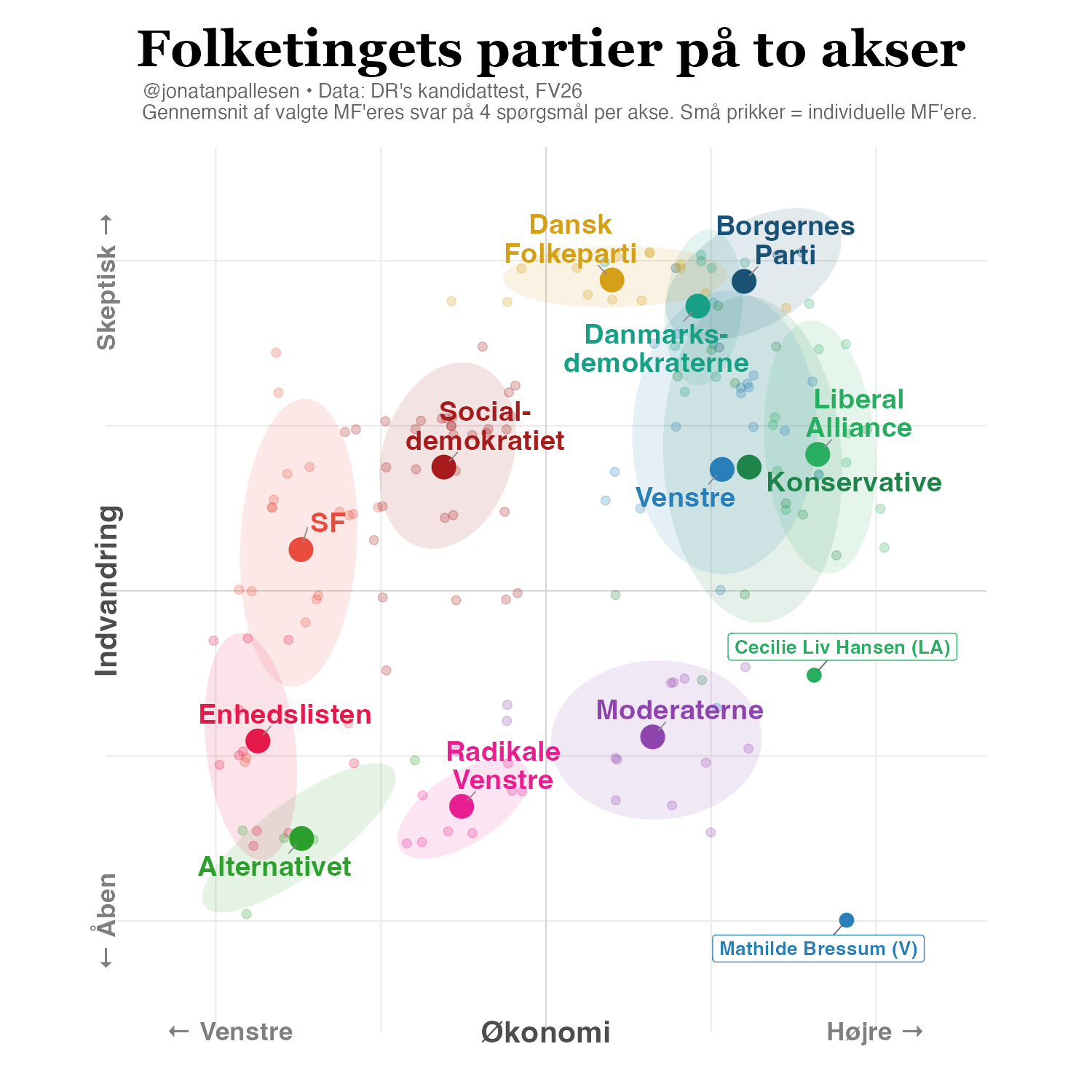
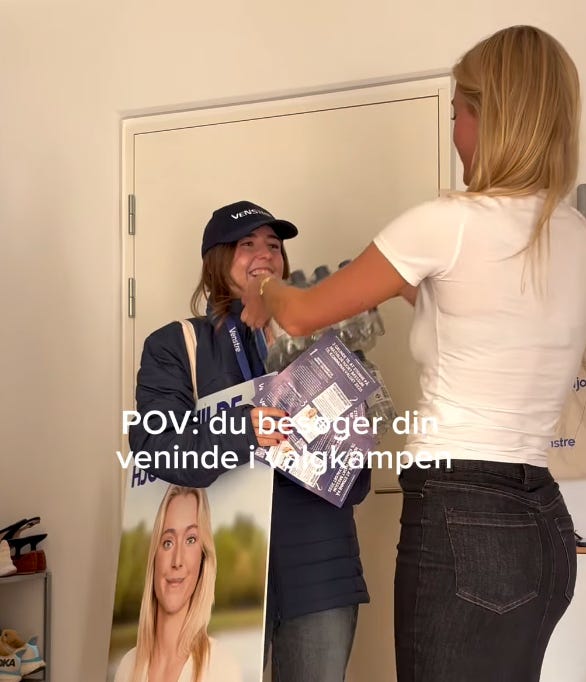
Notice also Mathilde Bressum in this figure. She is a 27-year-old woman who is far more pro-immigration than her party. She also has a more successful instagram than most politicians. Below is one of her posts (featuring the TikTok use of POV, which I suppose to them just means “video of”).
The candidate test is biased and bad
An open political question is whether DR, the public broadcaster, should keep receiving its current, very generous public funding. DR is widely accused of left-wing bias, and this is also reflected in who supports their funding, with all the left-wing parties being in favor, and all the right-wing parties being opposed.
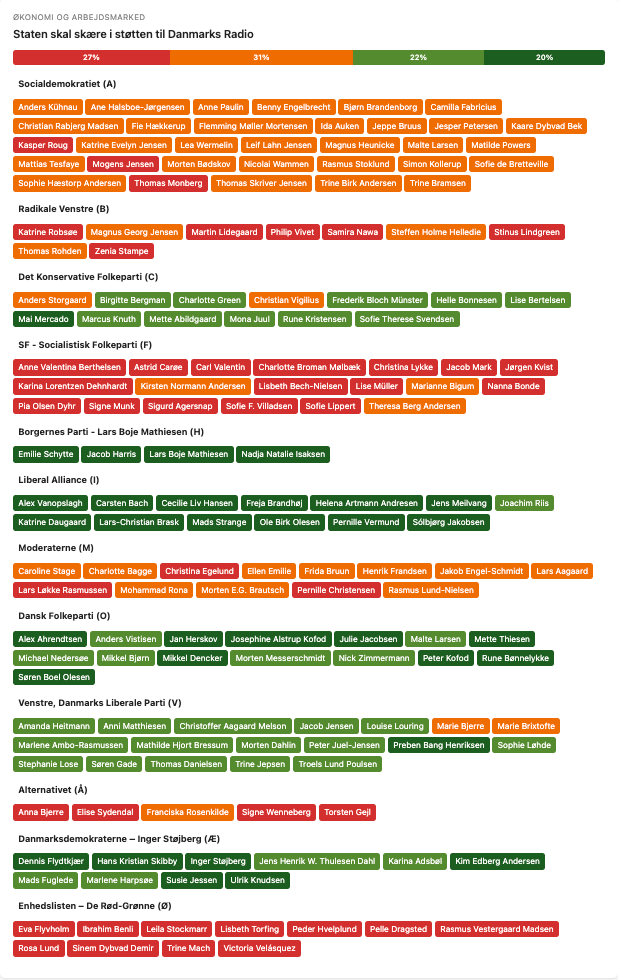
One may reasonably think that given this, maybe DR should not be participating in constructing the candidate test. The candidate test is highly influential, taken by a large proportion of Danes, and in many cases influencing or deciding who they vote for. But nonetheless, this is what happened. DR participated in making the test, and it is indeed highly biased and in many cases dumb.
What the test ought to do is ask general questions that separate the blocs first of all. Questions such as “Denmark has a good welfare system, and also the highest tax burden in the world. Should this tax level overall be increased or decreased?”, or “Continued Muslim immigration allows for asylum seekers and family reunification among other things, but also comes with large costs to taxpayers, and in form of increased crime. Are you in favor of keeping the current level of Muslim immigration or reducing it?”
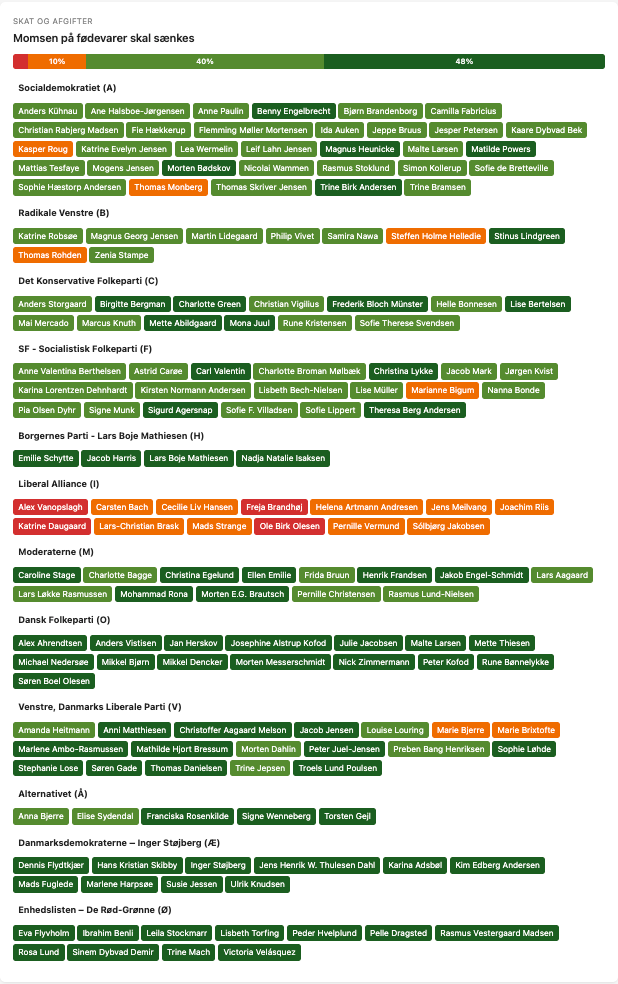
Questions in this vein would allow test takers to accurately place themselves in the blocs based on the most important issues. But this is not what the test does. Instead it asks more obscure questions, such as for example whether the value-added tax on food should be reduced. This is a question where, if you are in favor of generally lower taxes, you would probably answer yes. But if you do, you fell right into the trap! In fact, the only party against lowering the VAT on food is Liberal Alliance, by far the party that is overall most in favor of lower taxes. Their reason for being against this idea is that it is bureaucratically cumbersome to lower taxes just on food specifically. But a random low-information voter taking the test is not going to be aware of this. They are just going to take the test, and be less likely to be recommended Liberal Alliance.
And instead of asking overall about immigration, the test asks questions such as “It is more important that enough staff can be recruited for elderly care than whether they can speak Danish.”
But this is a crazy loaded question. I am more against immigration than most, but if I had to answer it honestly I may actually answer Yes to it. Because I don’t want the elderly to be neglected, and I think it’s better to have someone that doesn’t speak the language than no attending staff. And so will most test-takers, and then they will get recommended pro-immigration parties. But the question completely misses what the issues are regarding immigration and elderly care. The potential problems with immigrants are not mainly that they can’t speak Danish. The main problem is that they are exceedingly costly on average, and that they commit a lot of crime. There are even several cases of foreigners raping the elderly that they were supposed to care for. And furthermore the question supposes that if we don’t get these foreigners to take care of the elderly, there will “not be enough staff”, as opposed to us educating more people and paying a higher salary to attract more staff.
It is really quite a failure that all the right-wing parties let DR make such a test every election, and then always get fewer votes than they could have gotten. No one is doing anything about this, so it just keeps going.